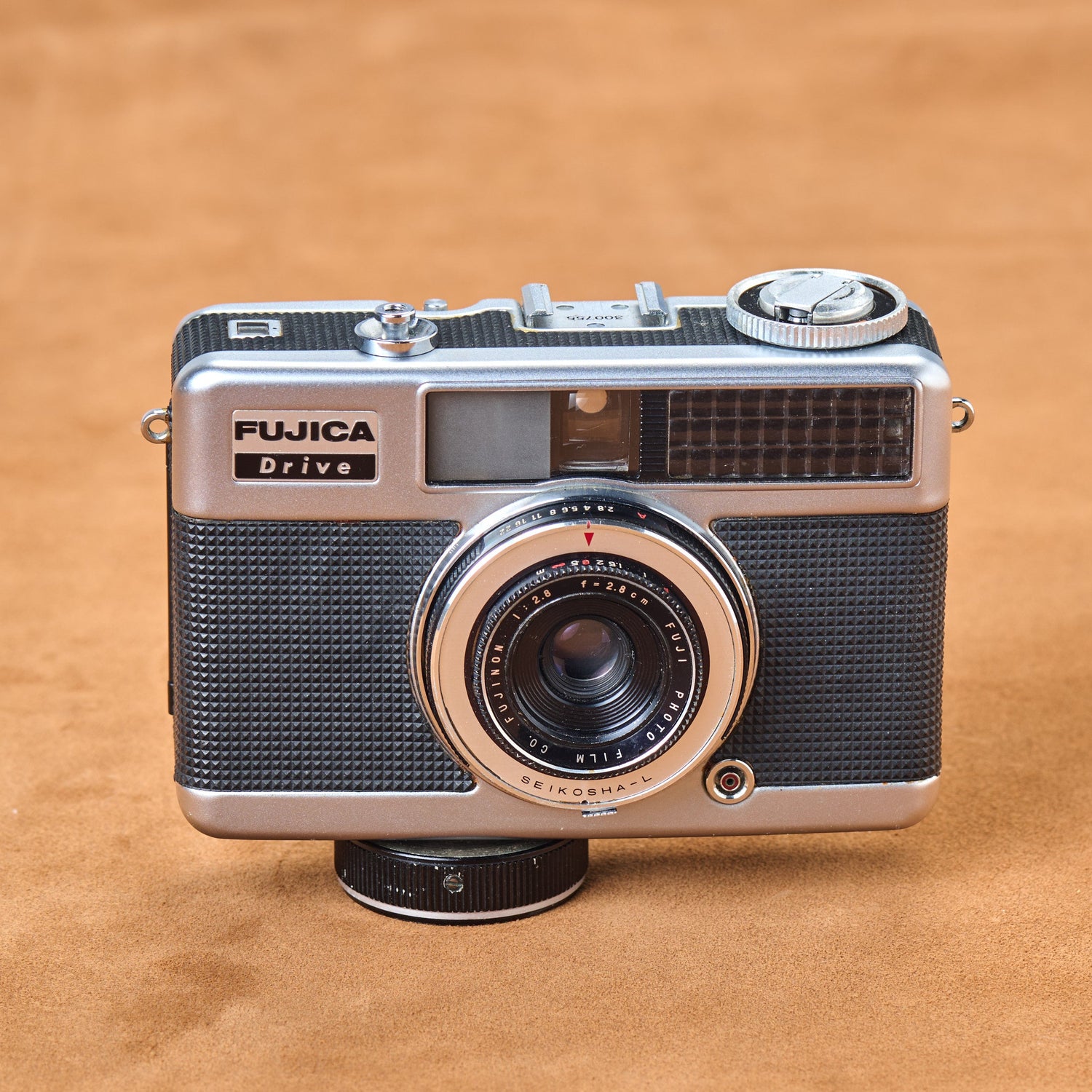
Fujica Half Drive Camera
WHAT CONDITION THE CONDITION IS IN: 88-Day Confirmed Operation Warranty. This camera is in great cosmetic condition. The viewfinder has been cleaned, the light seals replaced, and the shutter speeds are within acceptable tolerance. There is light dust inside the lens, but it doesn’t affect image quality. The clockwork motor works flawlessly. The built-in meter doesn’t work, but the camera is fully usable and makes a great user camera. Scroll down for the details, assuming you have the time and the curiosity. Both are optional.
In 1964, executives stared at the Fujica Half the way some men stare at a perfectly good martini before adding umbrellas and thought, "You know what this needs? More complexity." Because apparently, advancing film by hand wasn't elegant enough, so they added a spring-wound mechanical motor that automatically advances the film and cocks the shutter for up to 20 shots per wind, giving the camera a distinctive clockwork feel.
It's brilliantly unnecessary, like adding an automatic transmission to a bicycle. The Swiss make watches. The Japanese make watches that also take pictures. And somehow, it actually works beautifully.
This Fujica Drive, serial number 300755, is an early example of Fuji Photo Film Co.'s unique and collectible half-frame 35mm camera introduced in 1964, built on the design of the Fujica Half with a spring motor added because the Japanese approach to innovation has always been "yes, and also this."
It's fitted with a Fujinon 2.8cm f/2.8 lens that's genuinely excellent for street photography and offers both manual and automatic exposure modes powered by a selenium meter, though the meter on this unit is no longer accurate, so you'll need an external meter, but the spring motor still winds like a dream.
The sturdy all-metal construction gives it a solid, premium feel, and a standard 36-exposure roll yields 72 images measuring 24x18mm, with that spring motor delivering smooth, rapid-fire shooting that makes shooting feel effortless.
The Fujica Drive is what happens when Japanese engineers over-engineer something in exactly the right way. They took a practical camera and added mechanical wizardry that actually enhances the shooting experience. It's clever and wonderfully Japanese: solving problems with more precision than strictly necessary and somehow making you grateful they bothered.
