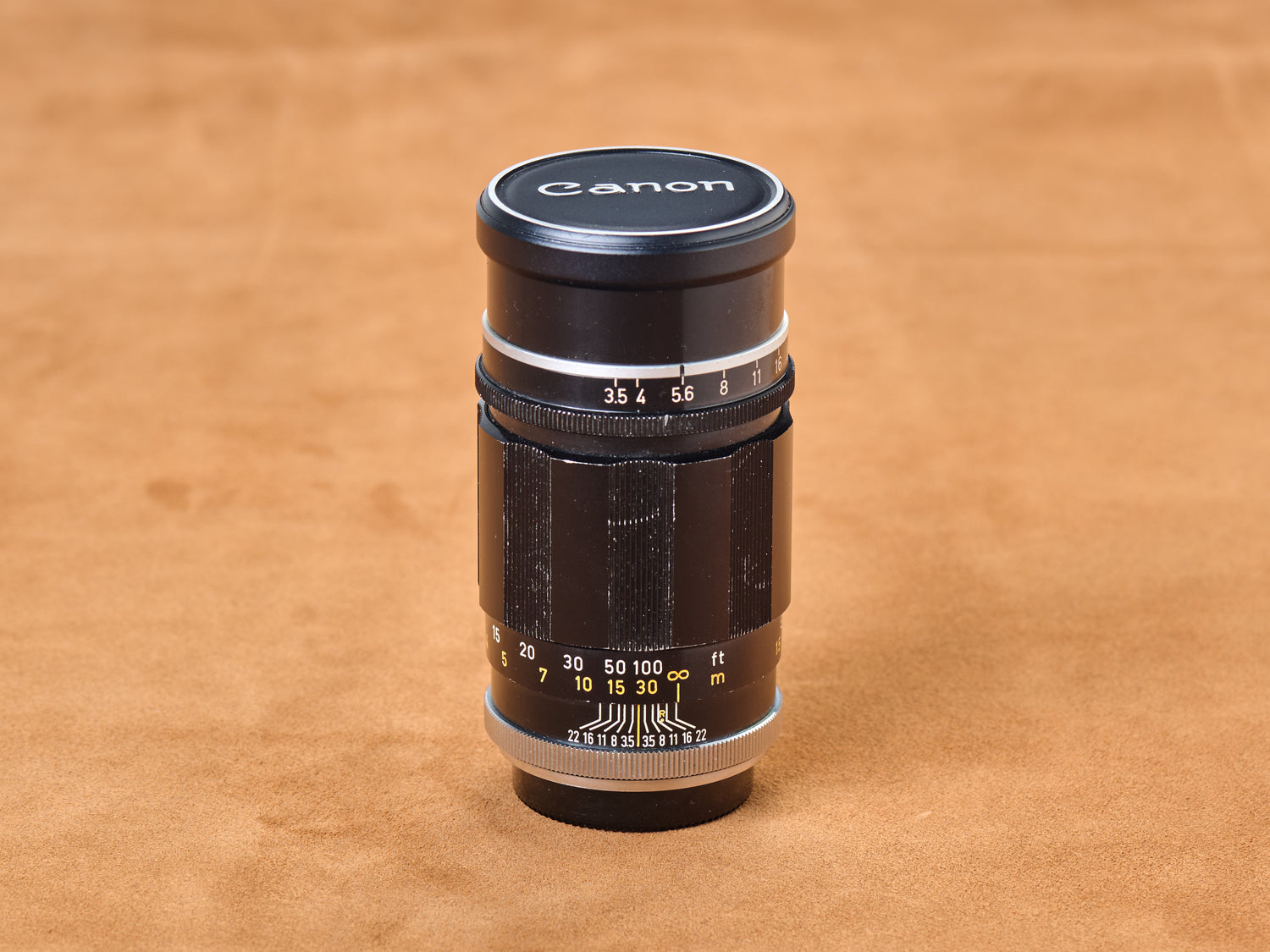
Canon 135mm f/3.5 LTM
WHAT CONDITION THE CONDITION IS IN: 88-Day Confirmed Operation Warranty. Cosmetically its in good shape, with some light wear on the barrel. Optically it has light dust excepted of a lens this old. Aperture ring functions as it should. Focus moves freely, but is heavy in spots. Original lens caps.
Introduced in 1952 and stubbornly lingering until the early '70s like a houseguest who's overstayed but remains impeccably polite, the Canon 135mm emerged in eight slightly different versions: enough to make collectors twitch with cataloging anxiety, but not enough to actually matter to anyone taking photographs. It's the lens equivalent of rearranging deck chairs. Different, technically, but you'd need a magnifying glass and a persecution complex to care.
Jiro Mukai (向井 治郎), the Canon engineer whose name sounds like it belongs to a haiku poet contemplating cherry blossoms rather than grinding optical glass, designed this lens with the quiet obsession of someone who believed four elements in three groups could achieve something approaching truth. A ten-blade iris shapes light from f/3.5 to f/22, which is photographer-speak for "stops down nicely," and there's a 48mm filter thread because even in 1952 someone understood that photographers enjoy spending money on circular pieces of glass they'll lose within six months.
Over its 23-year production run, the Canon 135mm didn't evolve in ways that'd trouble the average Instagram influencer's understanding of vintage gear. The differences were cosmetic: a slightly heavier barrel here, a subtly shinier finish there, the kind of minutiae that occupy men in online forums at 2 AM. These minor shifts are the lens's way of whispering, "I'm constant, darling, but I have a sense of style," which is really all any of us can hope to say after two decades of showing up to work every day doing essentially the same thing while pretending each version is somehow revolutionary.
